Programmatic Video Advertising: Complete Guide for Publishers in 2024
Programmatic video advertising has revolutionized how digital video inventory is bought and sold, creating unprecedented opportunities for publishers to monetize their content. As video consumption continues to surge across all devices, understanding programmatic video mechanics becomes crucial for maximizing ad revenue and maintaining competitive advantage.
What is Programmatic Video Advertising?
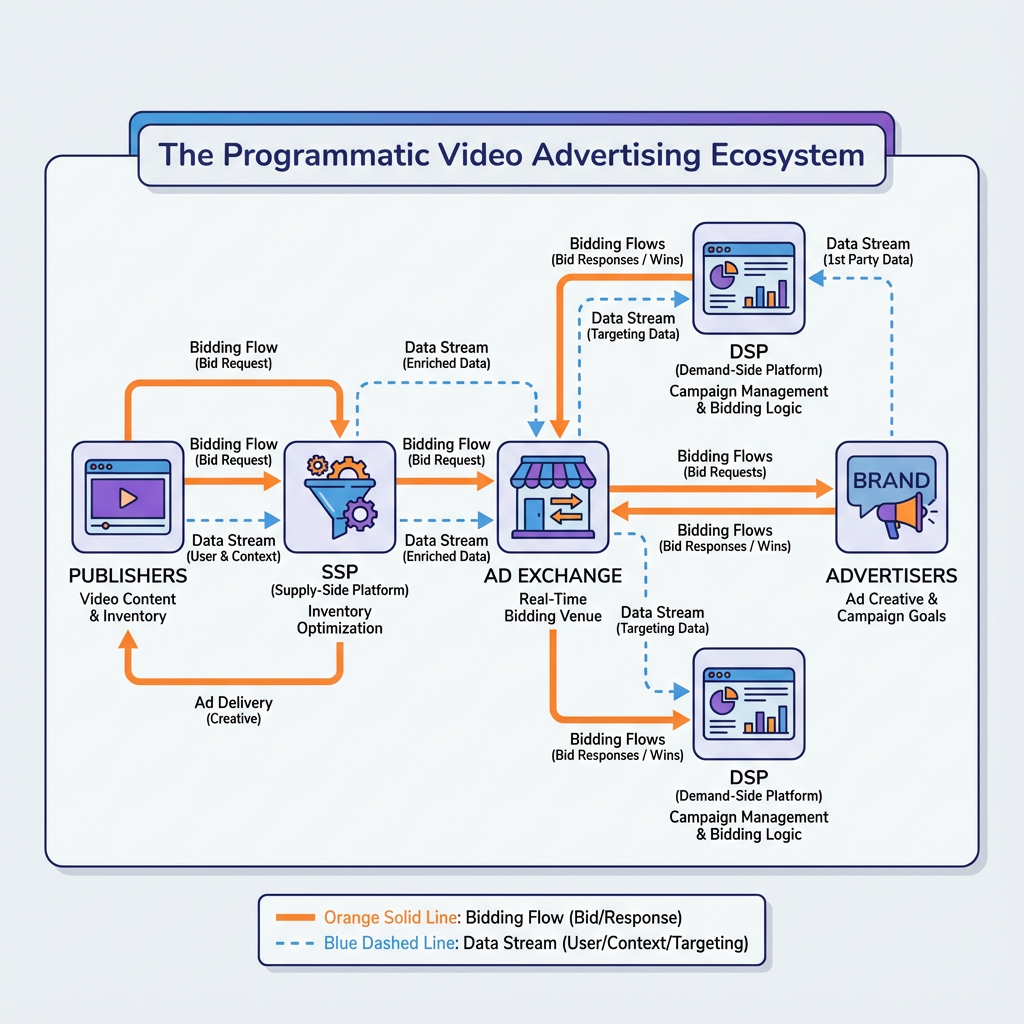
Programmatic video advertising refers to the automated buying and selling of video ad inventory through real-time bidding (RTB) platforms and programmatic marketplaces. Unlike traditional direct sales, this technology-driven approach uses algorithms and data to match advertisers with relevant audiences at scale, enabling millisecond-level decision making for ad placement.
The process involves sophisticated demand-side platforms (DSPs), supply-side platforms (SSPs), and ad exchanges that facilitate automated transactions between buyers and sellers. Publishers benefit from increased fill rates, optimized pricing, and reduced manual sales overhead, while advertisers gain access to precise targeting capabilities and real-time performance optimization.
Key Components of Programmatic Video Ecosystem
Supply-Side Platforms (SSPs): These platforms help publishers manage and sell their video inventory programmatically. Popular SSPs include Google Ad Manager, Amazon Publisher Services, and PubMatic.
Demand-Side Platforms (DSPs): Advertisers use DSPs to purchase video inventory across multiple exchanges simultaneously. Major players include The Trade Desk, Amazon DSP, and Google Display & Video 360.
Ad Exchanges: These digital marketplaces facilitate real-time auctions between buyers and sellers, with Google Ad Exchange and OpenX leading the market.
Types of Programmatic Video Auctions
Real-Time Bidding (RTB)
RTB represents the most common form of programmatic video buying, where advertisers bid on individual ad impressions in real-time auctions lasting approximately 100 milliseconds. Publishers benefit from competitive pricing as multiple demand sources compete simultaneously for each impression.
Advantages for Publishers:
- Maximum competition drives higher CPMs
- Automated optimization reduces manual intervention
- Access to global demand sources
- Real-time performance data and analytics
Private Marketplace (PMP)
PMPs offer invitation-only auctions where publishers provide select advertisers access to premium video inventory at negotiated floor prices. This approach combines programmatic efficiency with direct sales relationship benefits.
Implementation Strategy: Publishers should create PMP deals for high-value inventory segments, such as homepage video placements or specific content categories that command premium rates. Typical PMP CPMs run 20-40% higher than open marketplace rates.
Preferred Deals
Preferred deals allow advertisers to purchase video inventory at fixed prices before it enters the open auction. Publishers guarantee inventory availability while maintaining pricing control.
Best Practices:
- Set preferred deal prices 15-25% above historical averages
- Limit preferred deal volume to 30-40% of total inventory
- Monitor performance metrics to ensure deals remain profitable
Video Ad Formats in Programmatic
In-Stream Video Ads
In-stream ads play before (pre-roll), during (mid-roll), or after (post-roll) video content. These formats typically generate the highest CPMs due to their non-skippable nature and full-screen viewing experience.
Pre-roll Performance Metrics:
- Average completion rates: 70-85%
- Typical CPMs: $15-45 depending on vertical
- Optimal duration: 15-30 seconds
Mid-roll Optimization: Mid-roll placements require careful consideration of content length and natural break points. Publishers should implement mid-roll ads only in videos exceeding 8 minutes to avoid user experience degradation.
Out-Stream Video Ads
Out-stream ads display within editorial content areas, expanding when users scroll into view. While CPMs are lower than in-stream formats, out-stream ads provide additional monetization opportunities for publishers without existing video content.
Implementation Considerations:
- Ensure out-stream ads are clearly labeled as advertisements
- Implement viewability thresholds (50% visible for 2+ seconds)
- Monitor user engagement metrics to prevent negative UX impact
Connected TV (CTV) and Over-The-Top (OTT)
CTV/OTT represents the fastest-growing segment in programmatic video, with spending projected to exceed $18 billion in 2024. Publishers with streaming content should prioritize CTV monetization due to premium CPMs and limited ad load constraints.
CTV Best Practices:
- Implement server-side ad insertion (SSAI) for seamless user experience
- Utilize longer ad formats (30-60 seconds) typical in television
- Focus on brand-safe content to attract premium advertisers
Technical Implementation for Publishers
Header Bidding for Video
Header bidding enables publishers to receive bids from multiple demand sources simultaneously before calling their primary ad server. Video header bidding typically increases revenue by 10-30% compared to traditional waterfall setups.
Implementation Steps:
- Choose a wrapper solution: Prebid.js remains the industry standard for video header bidding implementation
- Configure demand partners: Integrate 6-8 quality demand sources to balance competition with latency
- Set appropriate timeouts: Video auctions require longer timeouts (1500-2000ms) compared to display
- Implement price granularity: Use dense price buckets ($0.01 increments) for optimal yield
Video Player Optimization
The video player significantly impacts programmatic performance and user experience. Publishers should ensure their video players support industry-standard protocols and provide comprehensive analytics.
Modern video player solutions like Veedmo offer built-in programmatic capabilities, advanced analytics, and seamless integration with major SSPs, simplifying implementation for publishers focused on maximizing video ad revenue.
VAST and VPAID Compliance
Video Ad Serving Template (VAST) and Video Player-Ad Interface Definition (VPAID) compliance ensures broad advertiser compatibility and optimal fill rates.
VAST Implementation Requirements:
- Support VAST 3.0+ specifications
- Handle linear and non-linear ad formats
- Implement proper error tracking and reporting
- Ensure cross-device compatibility
Optimization Strategies for Maximum Revenue
Floor Price Management
Dynamic floor pricing adapts reserve prices based on historical performance, demand patterns, and inventory characteristics. Publishers typically see 8-15% revenue increases through sophisticated floor price optimization.
Floor Price Strategy:
- Implement time-of-day pricing variations
- Adjust floors based on content categories
- Use audience data to set premium floors for valuable segments
- Monitor win rates to avoid overly aggressive pricing
Audience Data Utilization
First-party audience data significantly enhances programmatic video performance. Publishers should leverage registration data, viewing behavior, and content preferences to create targetable audience segments.
Data Activation Tactics:
- Create lookalike audiences based on high-value users
- Implement behavioral targeting for content affinity
- Use geographic data for location-based campaigns
- Develop custom segments for advertiser-specific needs
A/B Testing Framework
Systematic testing of ad configurations, placements, and formats helps optimize performance over time. Publishers should test variables including:
- Ad break frequency and duration
- Player size and positioning
- Skip button timing (where applicable)
- Companion banner configurations
Measuring Success: Key Performance Indicators
Revenue Metrics
Revenue Per Mille (RPM): Measures revenue generated per thousand video views, providing a normalized comparison across different traffic volumes and time periods.
Fill Rate: Percentage of ad requests successfully filled with paying advertisements. Target fill rates above 90% for optimal performance.
eCPM Trends: Effective cost per mille tracking helps identify performance patterns and optimization opportunities.
User Experience Metrics
Video Completion Rate (VCR): Percentage of video ads viewed to completion. Industry benchmarks range from 70-85% depending on format and placement.
Viewability Rate: Percentage of ads meeting viewability standards (50% visible for 2+ continuous seconds). Target rates above 70% for programmatic video.
Page Load Impact: Monitor how video ads affect overall page performance and user engagement metrics.
Industry Trends and Future Outlook
Privacy-First Programmatic Video
With third-party cookie deprecation and increased privacy regulations, publishers must adapt their programmatic video strategies to rely more heavily on first-party data and privacy-compliant targeting methods.
Preparation Strategies:
- Implement consent management platforms (CMPs)
- Develop first-party data collection strategies
- Test contextual targeting alternatives
- Prepare for Topics API and Privacy Sandbox adoption
Advanced Video Formats
Emerging formats like interactive video ads, shoppable video content, and augmented reality integrations present new monetization opportunities for forward-thinking publishers.
Artificial Intelligence Integration
AI-powered optimization tools increasingly automate complex decisions around pricing, placement, and audience targeting, enabling publishers to scale programmatic video operations more efficiently.
Common Implementation Challenges
Latency Management
Video ads require careful latency management to maintain user experience. Publishers should:
- Optimize header bidding timeouts
- Implement client-side caching where possible
- Use CDN distribution for video creative assets
- Monitor and optimize player initialization times
Brand Safety Considerations
Video content attracts premium brand advertisers who prioritize brand safety. Publishers should implement:
- Content categorization and labeling systems
- Keyword blocking and inclusion lists
- Third-party verification partnerships
- Regular content audits and policy updates
Conclusion
Programmatic video advertising offers publishers unprecedented opportunities to maximize revenue from video content. Success requires technical expertise, strategic optimization, and continuous adaptation to industry changes. Publishers who invest in proper implementation, testing frameworks, and performance monitoring will be well-positioned to capitalize on the continued growth in programmatic video spending.
The key lies in balancing automation efficiency with user experience quality, ensuring sustainable revenue growth while maintaining audience engagement. As the ecosystem evolves toward privacy-first solutions and advanced targeting capabilities, publishers must remain agile and data-driven in their approach to programmatic video monetization.