Video Ad Standards 2024: Complete Guide for Publishers & Ad Ops
Video advertising has evolved into a sophisticated ecosystem governed by technical standards that ensure seamless ad delivery across platforms and devices. For publishers and ad operations professionals, understanding these standards isn’t just beneficial—it’s essential for maximizing revenue, maintaining user experience, and staying competitive in the digital advertising landscape.
Understanding Video Ad Standards
Video ad standards are technical specifications that define how video advertisements are served, displayed, and tracked across different platforms and devices. These standards ensure interoperability between ad servers, video players, and measurement systems, creating a unified framework for the entire video advertising ecosystem.
The Interactive Advertising Bureau (IAB) has developed most of these standards in collaboration with industry stakeholders, addressing everything from ad serving protocols to interactive capabilities and measurement accuracy.
Core Video Ad Standards
VAST (Video Ad Serving Template)
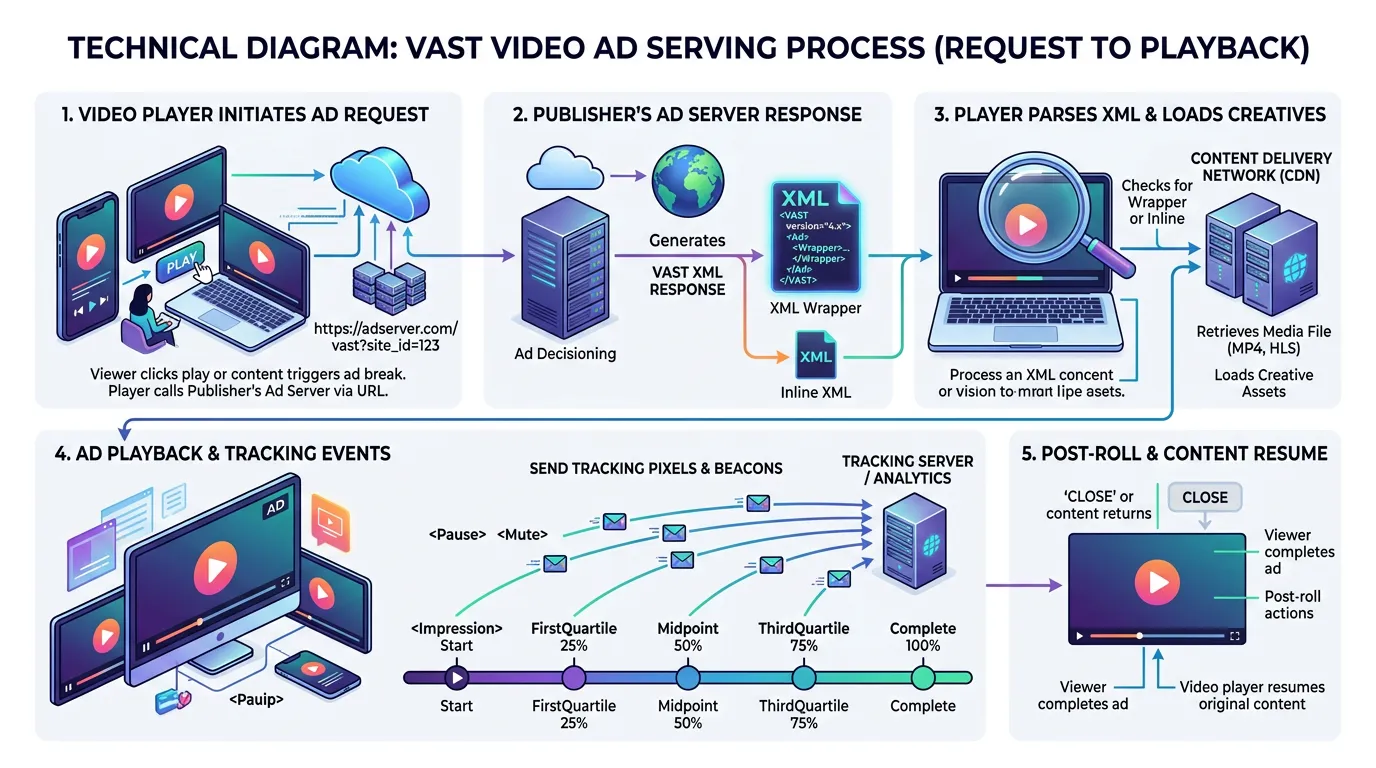
VAST is the foundational standard for video ad serving, providing a uniform way for video players to communicate with ad servers. The current version, VAST 4.2, defines the XML schema that ad servers use to describe video ad creatives and their delivery requirements.
Key VAST Features:
- Linear and non-linear ad support
- Multiple media file formats and bitrates
- Tracking events (impressions, quartiles, completion)
- Error handling and fallback mechanisms
- Skip functionality and companion ads
Practical Implementation: When a user initiates video playback, the video player requests a VAST tag from the ad server. The server responds with XML containing the ad creative URL, tracking pixels, and playback instructions. The player then loads and displays the ad according to these specifications.
VPAID (Video Player-Ad Interface Definition)
VPAID enables rich, interactive video advertisements by establishing a communication protocol between the video player and the ad creative. This standard supports advanced ad formats like interactive overlays, expandable ads, and mini-games within video content.
VPAID Capabilities:
- Interactive ad experiences
- Advanced tracking and measurement
- Dynamic creative optimization
- Real-time bidding integration
- Custom user interactions
Implementation Considerations: While VPAID offers enhanced functionality, it can impact page performance and user experience. Publishers should carefully balance interactive capabilities with site speed and implement proper fallback mechanisms for unsupported environments.
SIMID (Secure Interactive Media Interface Definition)
SIMID represents the next evolution of interactive video advertising, addressing VPAID’s security and performance limitations. By isolating ad creative execution in secure sandboxes, SIMID provides enhanced security while maintaining rich interactive capabilities.
SIMID Advantages:
- Improved security through sandboxing
- Better performance optimization
- Enhanced privacy protection
- Cross-platform compatibility
- Reduced technical complexity
Migration Strategy: Publishers should begin planning SIMID adoption while maintaining VPAID support during the transition period. This dual approach ensures maximum ad inventory compatibility while preparing for future industry standards.
VMAP (Video Multiple Ad Playlist)
VMAP defines how multiple video ads are scheduled and delivered within a single video stream. This standard is crucial for long-form content where multiple ad breaks occur throughout the viewing experience.
VMAP Applications:
- Pre-roll, mid-roll, and post-roll ad scheduling
- Ad pod management for connected TV
- Content-aware ad placement
- Dynamic ad insertion for live streams
- Personalized ad experiences
Connected TV and Streaming Video Standards
CTV Ad Standards Evolution
Connected TV advertising has introduced unique requirements that extend traditional web-based video ad standards. Publishers operating in the CTV space must consider additional factors including:
Technical Requirements:
- 10-foot viewing experience optimization
- Remote control navigation support
- Higher resolution creative specifications
- Extended ad duration capabilities
- Audio-first advertising support
FAST Channel Considerations: Free Ad-Supported Television (FAST) channels require specialized ad insertion capabilities that work seamlessly with streaming infrastructure. Publishers should ensure their video players support server-side ad insertion (SSAI) for optimal user experience.
Implementation Best Practices
Ad Server Integration
Successful video ad implementation requires careful consideration of ad server compatibility and optimization strategies:
Waterfall vs. Header Bidding: While traditional waterfall setups process ad requests sequentially, header bidding enables simultaneous bid requests to multiple demand sources, often resulting in higher yield for publishers.
Prebid Video Setup: Prebid.js offers robust video advertising capabilities through its video module, supporting both instream and outstream ad formats. Publishers should configure appropriate bid adapters and ensure proper VAST tag handling.
Video Player Optimization
The choice of video player significantly impacts ad performance and user experience. Modern video players should support:
- Multiple ad standard compatibility
- Adaptive bitrate streaming
- Cross-device playback optimization
- Advanced analytics and reporting
- Programmatic advertising integration
Solutions like Veedmo provide publishers with comprehensive video player capabilities designed specifically for optimized ad delivery and revenue maximization.
Ad Format Specifications
Pre-roll Advertising
Pre-roll ads appear before video content begins and typically achieve the highest completion rates among video ad formats.
Best Practices:
- Limit duration to 15-30 seconds for optimal completion
- Implement skip functionality after 5 seconds
- Ensure high-quality creative production
- A/B test different creative approaches
- Monitor completion rates and user engagement
Mid-roll Implementation
Mid-roll ads require careful content analysis to identify natural break points that don’t disrupt user experience.
Strategic Placement:
- Identify content natural breaks
- Implement frequency capping
- Consider content length and viewer engagement
- Use VMAP for precise ad timing
- Monitor user drop-off rates
Ad Pod Management
Ad pods containing multiple consecutive advertisements require sophisticated management to maintain viewer engagement while maximizing revenue.
Optimization Strategies:
- Vary creative types within pods
- Implement competitive separation
- Control total pod duration
- Use dynamic creative optimization
- Monitor pod-level performance metrics
Programmatic Video Advertising
Real-Time Bidding Integration
Programmatic video advertising relies on standardized protocols to enable real-time bidding across multiple demand sources.
Technical Requirements:
- OpenRTB video bid request formatting
- VAST creative validation
- Bid response timeout management
- Quality score optimization
- Brand safety implementation
Supply-Side Platform (SSP) Integration
Publishers should evaluate SSP partnerships based on:
- Video ad standard support
- Demand source diversity
- Technical integration capabilities
- Reporting and analytics features
- Revenue optimization tools
Measurement and Analytics
Tracking Implementation
Accurate measurement requires proper implementation of tracking pixels and event listeners throughout the video ad experience.
Key Metrics:
- Impression tracking and verification
- Quartile completion rates (25%, 50%, 75%, 100%)
- Click-through rates and engagement
- Viewability measurements
- Revenue per mille (RPM) optimization
Cross-Platform Attribution
Modern video advertising campaigns span multiple devices and platforms, requiring sophisticated attribution modeling to accurately measure campaign effectiveness.
Troubleshooting Common Issues
Ad Delivery Problems
VAST Error Handling: Implement comprehensive error tracking to identify and resolve ad delivery issues quickly. Common problems include:
- Creative loading failures
- Timeout errors
- Format compatibility issues
- Network connectivity problems
- Player compatibility conflicts
Performance Optimization
Page Load Impact: Video ads can significantly impact page performance if not properly optimized. Publishers should:
- Implement lazy loading for video players
- Optimize creative file sizes and formats
- Use content delivery networks (CDNs)
- Monitor Core Web Vitals impact
- A/B test different implementation approaches
Industry Trends and Future Developments
Privacy-First Advertising
Evolving privacy regulations and the deprecation of third-party cookies are reshaping video advertising approaches:
Adaptation Strategies:
- First-party data collection optimization
- Contextual advertising implementation
- Privacy-compliant user identification
- Server-side advertising solutions
- Consent management platform integration
Advanced Interactive Formats
Emerging interactive video formats require updated technical capabilities:
- Shoppable video advertisements
- Augmented reality integration
- Voice-activated advertising
- Gaming and entertainment crossover
- Social media integration
Conclusion
Video ad standards form the technical backbone of modern digital advertising, enabling publishers to deliver engaging ad experiences while maximizing revenue opportunities. Success requires staying current with evolving standards, implementing best practices for ad delivery and measurement, and maintaining focus on user experience throughout the monetization process.
Publishers who master these standards and their practical applications will be better positioned to capitalize on the continued growth of video advertising across all digital platforms. Regular evaluation and optimization of video ad implementations ensures sustained performance improvement and revenue growth in an increasingly competitive marketplace.