Video Monetization Platforms: Complete Guide for Publishers in 2024
Video monetization has become the cornerstone of digital publishing revenue strategies, with video content generating significantly higher CPMs than traditional display advertising. As publishers navigate an increasingly complex ecosystem of monetization platforms, understanding the landscape of available solutions, their technical requirements, and optimization strategies is crucial for maximizing revenue potential.
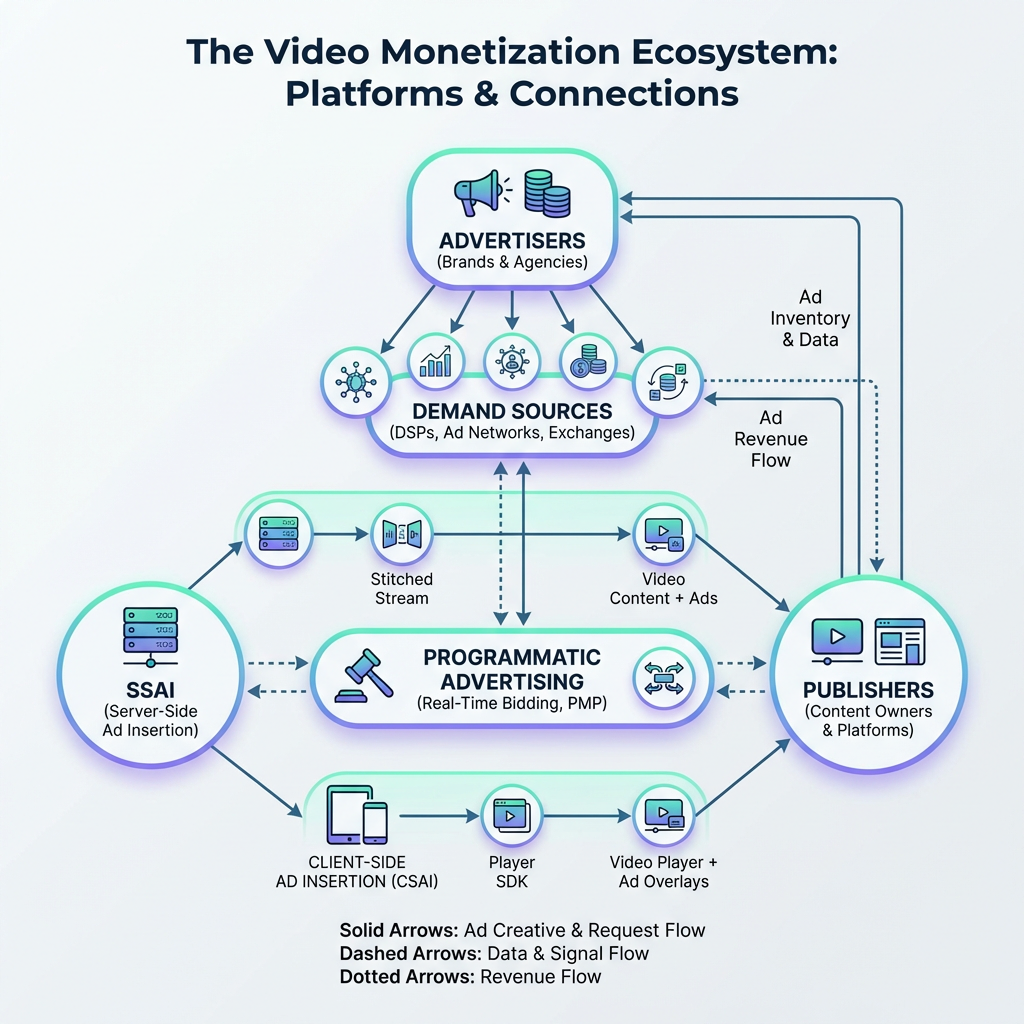
Understanding Video Monetization Platform Types
Server-Side Ad Insertion (SSAI) Platforms
Server-side ad insertion platforms represent the gold standard for video monetization, particularly for streaming content and Connected TV (CTV) environments. These platforms stitch ads directly into the video stream at the server level, creating a seamless viewing experience that’s resistant to ad blockers.
SSAI platforms excel in:
- Ad blocker resistance: Since ads are integrated server-side, they bypass client-side blocking
- Reduced latency: Eliminates the need for multiple client-server calls during ad breaks
- Universal compatibility: Works across all devices and platforms without additional plugins
- Advanced targeting: Enables sophisticated audience segmentation and personalization
Major SSAI platforms include Google Ad Manager’s Dynamic Ad Insertion, AWS Elemental MediaTailor, and SpotX (now Magnite Streaming). These platforms typically charge based on ad requests or revenue share models, with enterprise pricing starting around $0.01-0.05 per ad request.
Client-Side Video Ad Platforms
Client-side platforms execute ad logic within the user’s browser or application, offering publishers more control over the ad experience and typically faster implementation cycles. These platforms are particularly effective for publishers with existing video players who want to add monetization capabilities without overhauling their entire video infrastructure.
Client-side solutions leverage industry standards like VAST (Video Ad Serving Template) and VPAID (Video Player-Ad Interface Definition) to ensure broad compatibility across different video players and ad networks. Publishers using solutions like Veedmo for their video player infrastructure can easily integrate with multiple client-side monetization platforms through standardized ad serving protocols.
Key advantages include:
- Faster deployment: Integration typically requires only tag implementation
- Granular control: Publishers maintain direct oversight of ad serving logic
- Cost efficiency: Often feature lower platform fees than SSAI solutions
- Real-time optimization: Immediate access to performance data for quick adjustments
Programmatic Video Platforms
Programmatic platforms have revolutionized video monetization by enabling real-time bidding (RTB) for video ad inventory. These platforms connect publishers to demand-side platforms (DSPs), ad exchanges, and direct advertisers through automated auction mechanisms.
Programmatic video monetization offers several distinct advantages:
Yield Optimization: Multiple demand sources compete simultaneously, driving up CPMs through competitive bidding. Publishers typically see 15-40% revenue increases when transitioning from direct sales to programmatic.
Audience Monetization: Advanced data integration allows for premium audience segment monetization. Publishers can leverage first-party data, contextual signals, and third-party data partnerships to create high-value audience packages.
Global Demand Access: Programmatic platforms provide access to international demand sources, crucial for publishers with global audiences seeking to monetize traffic across different geographic regions.
Ad Format Implementation and Revenue Impact
Pre-Roll Advertising
Pre-roll advertisements appear before video content begins and typically generate the highest CPMs due to guaranteed viewability and user attention. Industry data shows pre-roll ads achieve completion rates of 85-95% for videos under 15 seconds, making them highly attractive to advertisers.
Optimal pre-roll implementation strategies include:
- Length optimization: 6-15 second ads achieve the best balance of completion rates and advertiser satisfaction
- Frequency capping: Limiting pre-roll exposure to 1-2 ads per user per hour maintains user experience
- Contextual alignment: Matching ad content to video subject matter increases engagement by 23% on average
Mid-Roll and Ad Pods
Mid-roll advertising integrates ads within content, similar to traditional television commercial breaks. Ad pods (multiple consecutive ads) can significantly increase revenue per video view but require careful implementation to avoid user abandonment.
Best practices for mid-roll monetization:
- Natural break points: Insert ads at scene transitions or logical content breaks
- Progressive loading: Use VMAP (Video Multiple Ad Playlist) to define multiple ad opportunities without disrupting content flow
- Pod composition: Optimize ad pod length based on content duration (1-2 ads for 5-10 minute videos, 3-4 ads for 15+ minute content)
Data from major streaming platforms indicates that well-implemented mid-roll advertising can increase overall video revenue by 40-60% compared to pre-roll only strategies.
Interactive Ad Formats
Interactive video advertisements enable user engagement beyond passive viewing, typically commanding premium CPMs due to enhanced advertiser value. These formats include clickable overlays, shoppable video content, and gamified ad experiences.
Interactive ad implementation requires:
- SIMID compatibility: The Secure Interactive Media Interface Definition ensures interactive ads function across different video players and environments
- Mobile optimization: Touch-friendly interactive elements designed for mobile viewing experiences
- Performance tracking: Advanced analytics to measure engagement depth beyond standard completion metrics
Header Bidding for Video Monetization
Header bidding has transformed video monetization by enabling simultaneous competition among multiple demand sources before ad server decisioning. Video header bidding typically increases revenue by 20-35% compared to traditional waterfall implementations.
Technical Implementation
Video header bidding requires careful technical integration to avoid latency issues that could impact user experience. Key implementation considerations include:
Timeout Management: Video header bidding auctions should complete within 1-2 seconds to prevent content delays. Publishers must balance timeout length with demand partner participation.
Prebid Integration: Prebid.js video modules provide standardized header bidding implementation with support for major demand partners. The platform offers built-in analytics and optimization tools specifically designed for video inventory.
Cache Management: Video creatives require pre-loading and caching strategies to ensure smooth playback transitions between content and advertisements.
Demand Partner Selection
Successful video header bidding implementations typically include 8-12 demand partners to maximize competition while managing latency. Publishers should prioritize partners based on:
- Geographic coverage: Ensuring strong demand across all audience locations
- Format support: Compatibility with all implemented ad formats (pre-roll, mid-roll, interactive)
- Data integration: Ability to leverage publisher first-party data for enhanced targeting
Platform Selection Criteria for Publishers
Revenue Share vs. Fixed Fee Models
Video monetization platforms typically employ either revenue sharing or fixed fee pricing models, each with distinct advantages depending on publisher scale and goals.
Revenue Share Models (typically 10-30% of ad revenue):
- Advantages: No upfront costs, platform incentivized for publisher success
- Disadvantages: Ongoing revenue reduction, less predictable costs at scale
- Best for: Smaller publishers, experimental implementations
Fixed Fee Models (monthly or per-impression pricing):
- Advantages: Predictable costs, higher profit margins at scale
- Disadvantages: Upfront investment, risk if traffic fluctuates
- Best for: Established publishers with consistent traffic
Integration Complexity Assessment
Publishers must evaluate technical integration requirements against available development resources:
Low Complexity: JavaScript tag implementations with existing video players Medium Complexity: API integrations requiring custom development High Complexity: Complete infrastructure overhauls with SSAI implementations
Performance and Analytics Requirements
Modern video monetization platforms should provide comprehensive analytics including:
- Real-time revenue reporting: Immediate visibility into monetization performance
- Viewability metrics: Detailed measurement of ad viewability across different placements
- User experience monitoring: Analysis of loading times, completion rates, and abandonment
- A/B testing capabilities: Tools for optimizing ad frequency, placement, and format selection
Emerging Trends in Video Monetization
Connected TV and FAST Channels
Connected TV advertising represents the fastest-growing segment of video monetization, with spending projected to exceed $40 billion by 2025. FAST (Free Ad-Supported Television) channels offer publishers opportunities to create linear streaming experiences monetized entirely through advertising.
FAST channel monetization strategies include:
- Premium content packaging: Curating high-quality content libraries to attract advertiser interest
- Audience data integration: Leveraging viewing behavior data for advanced targeting capabilities
- Cross-platform promotion: Using owned media properties to drive FAST channel viewership
Advanced Targeting and Personalization
AI-powered targeting capabilities are enabling more sophisticated audience segmentation and personalized ad experiences. Machine learning algorithms analyze viewing behavior, content preferences, and engagement patterns to optimize ad selection and timing.
Advanced targeting implementation includes:
- Behavioral segmentation: Grouping users based on viewing patterns and content preferences
- Contextual analysis: Real-time content analysis to match relevant advertisements
- Predictive modeling: Anticipating user behavior to optimize ad placement and frequency
Optimization Strategies for Maximum Revenue
Multi-Platform Testing
Publishers should implement systematic testing across different monetization platforms to identify optimal solutions for their specific audience and content mix. A/B testing frameworks should compare:
- Revenue per thousand impressions (RPM): Direct financial impact comparison
- User engagement metrics: Bounce rates, session duration, return visitor rates
- Technical performance: Page load speeds, ad loading latency, error rates
Seasonal and Content-Based Optimization
Video monetization performance varies significantly based on seasonal advertising demand and content category. Publishers should develop optimization strategies that account for:
- Quarterly demand cycles: Adjusting inventory allocation based on advertiser spending patterns
- Content category performance: Identifying high-performing content types for inventory expansion
- Geographic optimization: Tailoring monetization strategies for different regional markets
Advanced Analytics Implementation
Successful video monetization requires sophisticated analytics beyond standard reporting. Publishers should implement:
Cohort Analysis: Understanding how different user segments interact with video content and advertisements over time.
Attribution Modeling: Tracking user journeys across multiple video touchpoints to optimize content and ad strategies.
Predictive Analytics: Using machine learning to forecast revenue trends and identify optimization opportunities.
Conclusion
Video monetization platforms offer publishers unprecedented opportunities to generate revenue from video content, but success requires strategic platform selection, technical expertise, and ongoing optimization. As the ecosystem continues evolving with new formats, targeting capabilities, and distribution channels, publishers who invest in comprehensive monetization strategies and maintain technical agility will achieve the strongest financial results.
The key to successful video monetization lies in balancing user experience with revenue generation, leveraging data for optimization, and staying ahead of industry trends. Publishers should regularly evaluate their monetization stack, test new platforms and formats, and invest in the analytics capabilities necessary to make data-driven optimization decisions.